

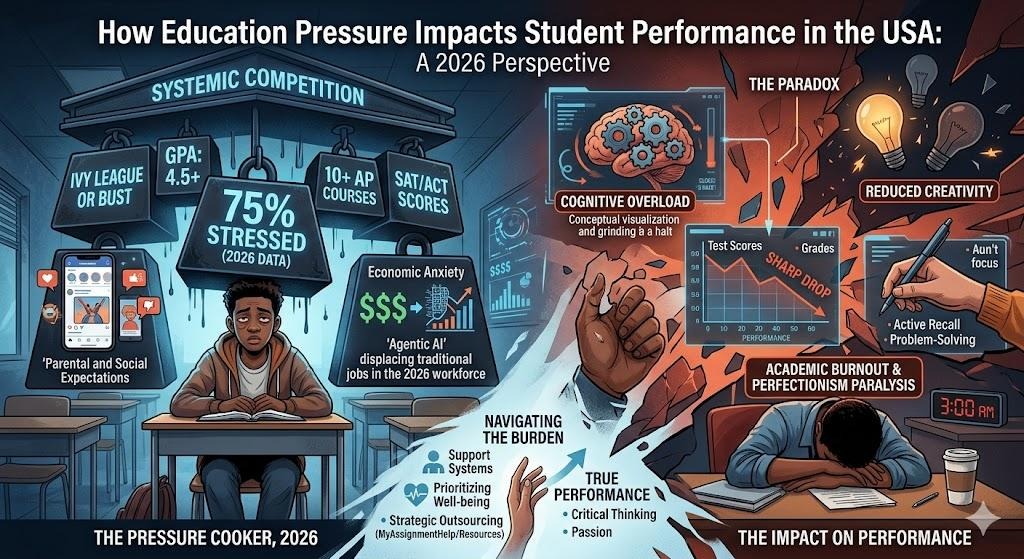
In the modern American landscape, the path to success is often painted as a narrow, high-stakes climb. From the moment a student enters a high-performance ZIP code or a competitive high school, the narrative is clear: Grade Point Averages (GPAs), Advanced Placement (AP) counts, and SAT/ACT scores are the primary currencies of worth.
As a Senior Content Manager and Academic Strategy Consultant with over a decade of experience in the higher education sector, I have observed how the intensity of “education pressure” in the USA has reached a boiling point. For high schoolers aiming for the Ivy League and college students juggling internships with rigorous coursework, the impact of this pressure on performance is a complex, often detrimental, phenomenon. Recent studies from early 2026 indicate that nearly 75% of American high school students report “often or always” feeling stressed by their schoolwork—a statistic that underscores a growing national crisis.
The Anatomy of Education Pressure in the USA
Education pressure isn’t a single force; it is a multifaceted weight coming from three primary directions:
- Systemic Competition: The “College Admissions Arms Race” has forced high school students to pack their schedules with more than just academics. To stand out, students feel they must be varsity athletes, community leaders, and academic prodigies simultaneously.
- Economic Anxiety: With the rising cost of tuition and a volatile job market, students feel a single “C” grade could derail their financial future. This is particularly prevalent in 2026, where the rapid integration of Agentic AI in the workforce has made specialized degrees and “perfect” transcripts seem like the only safety nets. Often, students facing these high stakes look for specialized data science assignment help to ensure their technical projects meet the rigorous standards of modern industry.
- Parental and Social Expectations: In many American households, academic achievement is tied to family pride. Social media further exacerbates this, as students compare their “behind-the-scenes” struggles with their peers’ “highlight reels” of Ivy League acceptance letters.
The Paradox: Why More Pressure Leads to Lower Performance
It is a common misconception that more pressure equals better results. In psychology, the Yerkes-Dodson Law suggests that performance increases with mental arousal, but only up to a point. Once stress crosses a threshold, performance drops sharply.
1. Cognitive Overload and the “Fight or Flight” Brain
The human brain, particularly the developing adolescent brain, has a finite capacity for stress. When a student is constantly anxious about their grades, the prefrontal cortex—the area responsible for complex decision-making and creative problem-solving—is compromised. This leads to:
- Memory Impairment: High cortisol levels interfere with the brain’s ability to form new memories and retrieve old ones during exams.
- Reduced Creativity: Students become so focused on “getting the right answer” for the test that they lose the ability to think critically or innovate. Under such immense time constraints, the impulse to simply ask a peer to do my coding assignment becomes a survival mechanism rather than a lack of interest, as the brain prioritizes immediate relief over deep learning.
2. The Rise of “Academic Burnout”
Burnout isn’t just for corporate executives. High school and college students in the USA are reporting academic burnout signs at record rates. Defined by emotional exhaustion and a sense of reduced accomplishment, burnout creates a cycle where the student spends more hours studying but retains less information. According to the American Psychological Association (APA), chronic stress is now linked to a significant drop in long-term cognitive retention among university students.
Transitioning the Burden: From High School to College
The nature of this pressure shifts as a student moves from the K-12 system into higher education. In high school, the pressure is often external (parents, teachers, and college recruiters). In college, the pressure becomes internal and professional.
University students in 2026 face “Digital Burnout,” caused by the 24/7 nature of online portals, AI-driven grading systems, and the constant need to upskill. The transition is often where the “crash” happens, as the coping mechanisms used in high school—such as rote memorization and sleep deprivation—fail to hold up against the rigors of a university thesis or a complex engineering project.
Navigating the Burden: When to Seek Support
As the curriculum gets tougher, acknowledging when you need help is a sign of professional maturity, not academic weakness. In the American education system, the most successful students are often those who know how to manage their resources effectively.
For many, this means moving beyond the “solitary scholar” myth. When the workload exceeds the hours in a day, high-performing students look for reliable frameworks to structure their thoughts. This is where strategic outsourcing becomes a vital skill. Whether it’s through peer study groups, faculty office hours, or specialized platforms like MyAssignmentHelp, finding a support system is essential to maintaining performance without sacrificing mental well-being. Using these resources allows students to refocus on deep learning rather than just surviving a deadline.
The Shift in Performance Metrics: Quality vs. Quantity
Interestingly, the USA’s educational elite are starting to realize that the “pressure cooker” model is broken. Top-tier universities are moving toward holistic admissions, looking for “well-angled” students who show deep passion in one area rather than “well-rounded” ones who are burnt out. To maintain high performance, students must shift their mindset:
- Active Recall over Cramming: Scientific studies show that short, intense bursts of focused study are more effective than 8-hour marathon sessions fueled by caffeine and anxiety.
- Prioritizing Sleep: The American Academy of Sleep Medicine notes that sleep deprivation is a leading cause of poor academic performance. A brain that hasn’t slept is functionally similar to a brain that is intoxicated.
- The Delegation Mindset: In the professional world, leaders delegate. Students can learn from this by using academic tools to manage secondary tasks, allowing them to focus on mastering core concepts that will define their careers.
The Achievement Gap and Resource Accessibility
The impact of education pressure isn’t distributed equally. The “achievement gap” in the USA is often widened by who can afford to “buy back” their time. Students from affluent backgrounds have access to private tutors and high-end mental health resources to mitigate the pressure.
In contrast, students from lower-income backgrounds are often left to shoulder the weight alone, leading to higher dropout rates despite their intellectual potential. Democratizing access to academic tools is essential for equity. Platforms like MyAssignmentHelp serve as a vital bridge, providing professional-grade guidance to students who may not have access to expensive local tutoring networks, ensuring that success isn’t just a privilege of the few.
The Long-Term Impact: Perfectionism Paralysis
The impact of education pressure doesn’t end at graduation. We are seeing a generation of young professionals entering the workforce with “perfectionism paralysis.“ Because they were raised in an environment where a 95% was seen as a failure, they struggle with the trial-and-error nature of the real-world job market. Furthermore, a decline in “intrinsic motivation” means students are learning for the grade, not for the knowledge, creating a workforce that is excellent at following instructions but struggles with the ambiguity required for modern innovation.
Breaking the Cycle: A Guide for 2026 Students
If you are a high school or college student feeling the weight of the American education system, here is how you can reclaim your performance:
- Define Your Own Success: Don’t let a ranking determine your value. Identify the subjects you are genuinely passionate about and allow yourself to be “good enough” in the others.
- Practice “Radical Self-Care”: This means setting boundaries. It’s saying “no” to an extra extracurricular activity if it means you can get eight hours of sleep.
- Utilize Your Resources: Don’t drown in silence. If a specific subject is dragging down your entire semester, find a mentor or visit MyAssignmentHelp to get the specific guidance you need to get back on track.
- Advocate for Change: Support initiatives like “Wellness Days” or “No-Homework Weekends” in your local school district.
Conclusion
Education pressure in the USA is a double-edged sword. While it can drive students to reach incredible heights, it can also lead to a catastrophic collapse in performance and mental health. True student performance isn’t measured by the ability to survive a breakdown; it’s measured by sustainable growth, critical thinking, and a genuine love for learning. By acknowledging the reality of this pressure and utilizing the support systems available to us—from school counselors to academic assistance platforms—we can move toward an educational future where American students don’t just “perform”—they thrive.
Frequently Asked Questions
Q.1 How does academic pressure specifically affect student mental health in the USA?
Chronic academic pressure triggers the body’s stress response, leading to sustained high levels of cortisol. In the U.S. student population, this has manifested as a sharp rise in clinical anxiety. When a student’s self-worth is tied exclusively to their GPA, a single academic setback can lead to severe emotional distress.
Q.2 What are the first signs of academic burnout in high schoolers?
Common red flags include persistent exhaustion, a cynical attitude toward school, a sudden drop in grades, and physical symptoms like frequent headaches. If a student is spending more hours studying but seeing diminishing returns, they are likely experiencing burnout.
Q.3 Is “strategic outsourcing” or using academic help services considered ethical?
Yes, when used correctly as a supplemental learning tool. Just as a professional manager delegates tasks to focus on high-level strategy, students can use services like MyAssignmentHelp to gain clarity on complex topics or manage heavy workloads, provided they use the guidance to enhance their own understanding of the material.
Q.4 How are U.S. universities changing their view on student performance?
Many elite institutions are moving toward “holistic admissions.” They are increasingly looking for students who show genuine passion and resilience rather than those who have simply checked every box at the expense of their mental health.
Q.5 Can sleep deprivation actually lower a student’s performance?
While it doesn’t permanently lower IQ, sleep deprivation severely impairs the prefrontal cortex. This results in poor concentration and weakened memory recall, making a student functionally less capable during exams and class discussions.
About the Author
Drake Miller is a senior content manager and academic strategy consultant based in the USA.. With over 12 years of experience in higher education, Drake specializes in student success strategies and the ethical integration of AI in academia.
